

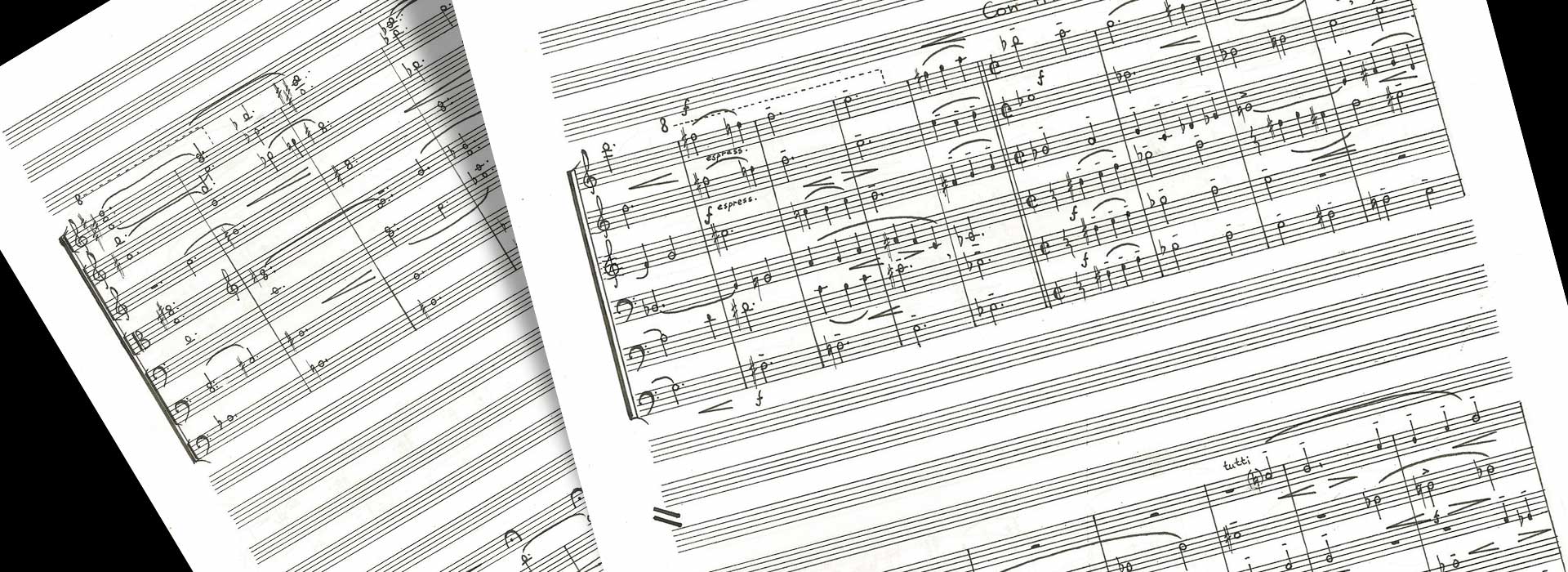
“Harmless Music” (2026) for chamber ensemble OP.127
A piece for flute, clarinet in B, bassoon, violin, cello and piano
This chamber work began as a deliberate act of compositional “permission.” Two German professors from the composer’s past each left a memorable mantra: one would dismiss insufficiently characterful student pieces as “rather harmless,” while the other urged his students to overcome procrastination by learning “to write bad pieces.” Sitting after the completion of a large-scale work and wondering what to write next, the composer found both sayings returning at once. The result was a decision to compose, without further ado, exactly that: a “harmless” piece of music.
Accordingly, Harmless Music is built on clear, at times deliberately simplistic structural principles. It carries no declared philosophical agenda, no hidden narrative, and no program beyond its own unfolding. It favors instead an immediate, almost offhand musical gesture.
Listeners may recognize familiar quotations or allusions: Stravinsky’s Symphony of Psalms, the DSCH motif associated with Shostakovich mixed with the main theme from the first movement of Beethoven’s Piano Sonata No. 32, Op. 111, and La campanella, the celebrated finale of Paganini’s Second Violin Concerto. Their appearance is not part of a hidden “conspiracy.” Rather, they reflect the composer’s ongoing contemplation of time and musical and cultural synthesis—a part of stream of consciousness.
What began as an exercise in ease and spontaneity, however, gradually revealed its own inner logic and character. In the end, the piece may be neither as “bad” nor as “harmless” as its title suggests—only straightforwardly itself.