

“Caprichos” (2026) for Oboe, Bassoon and Cello Op.126
Chamber work by Uri Brener, inspired by the late works of Francesco Goya (see more below)
1. Capricho Jota
2. Lambkins Serenata
3. Fugato 1 / “Ni Mas Ni Menos”
4. Burlesque
5. Fugato 2, Self-portrait
6. Fandango
7. Pavane
8. “The Sleep of Reason”

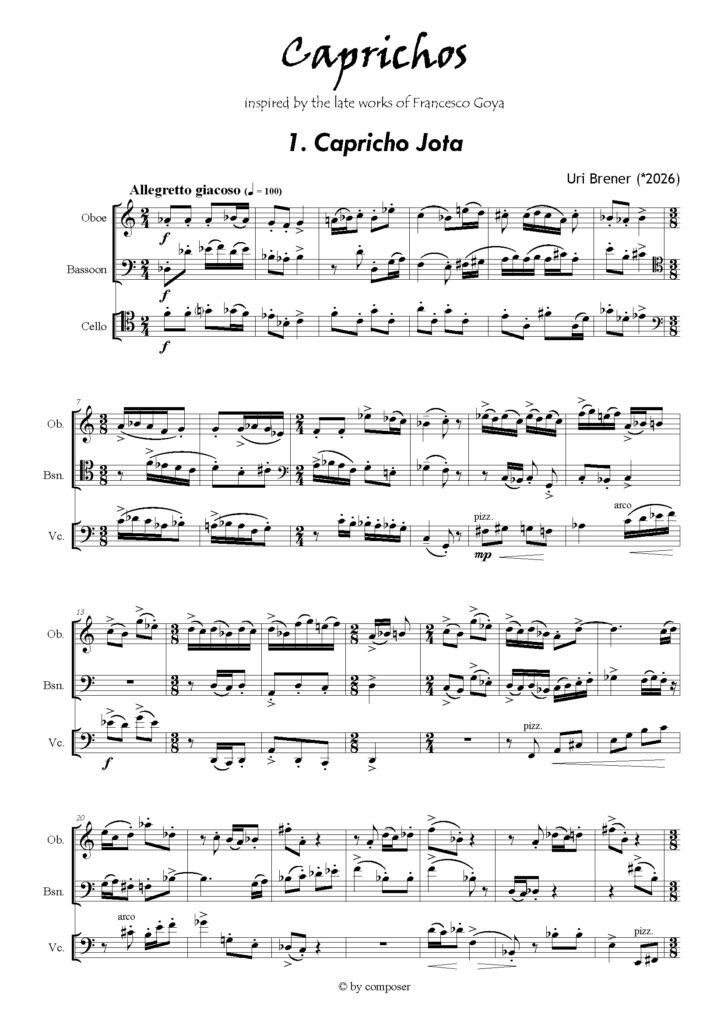
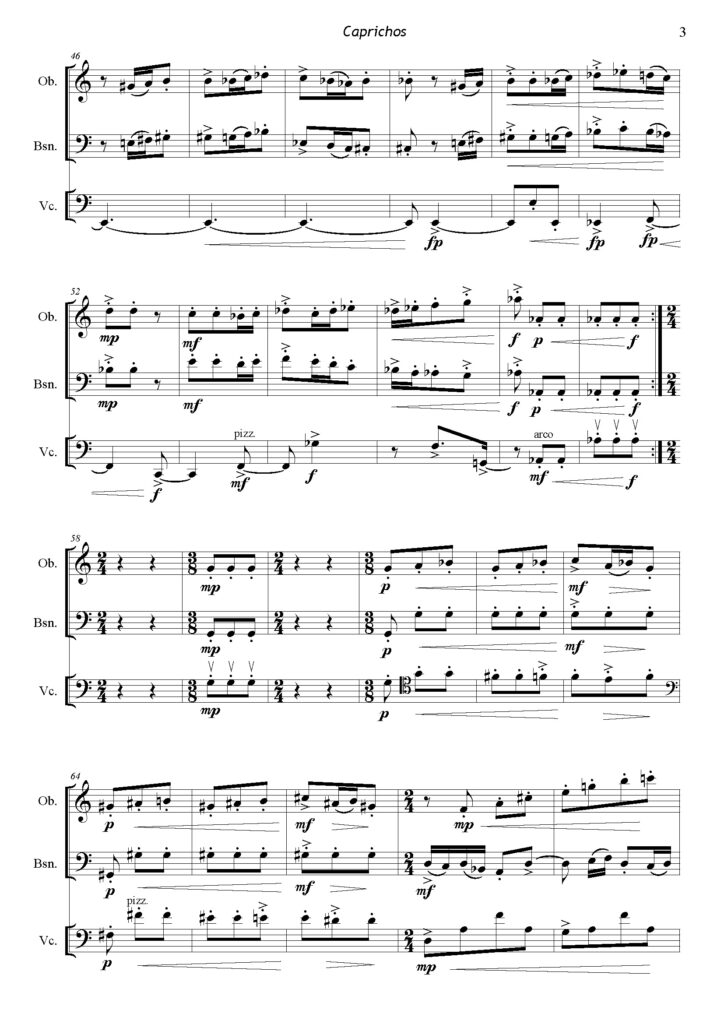
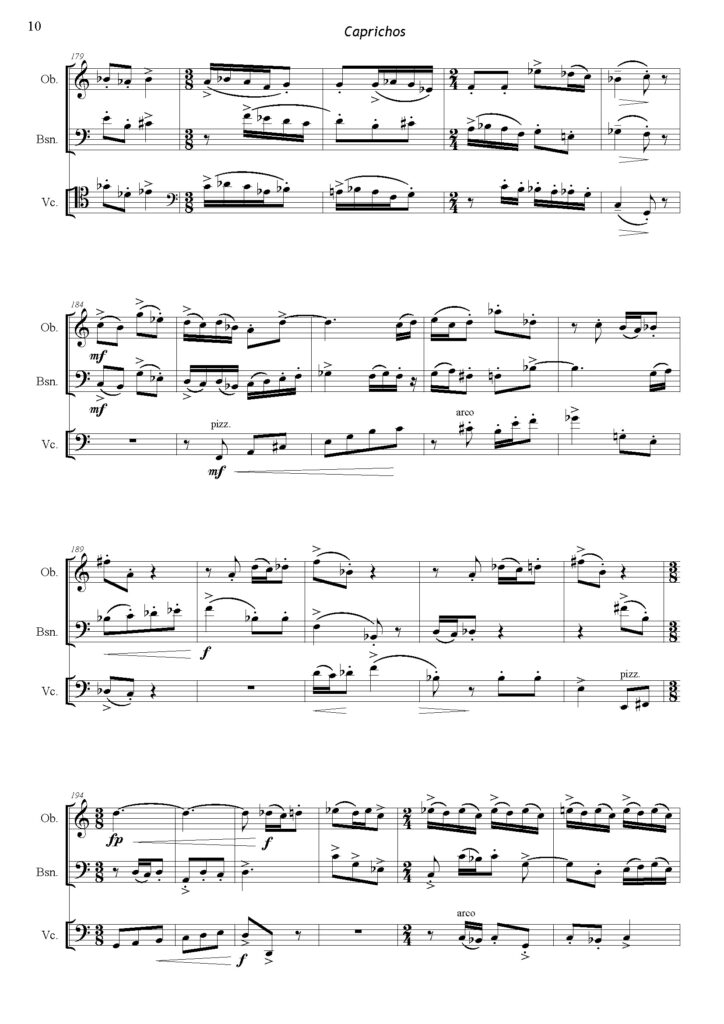
Caprichos is a cycle for oboe, bassoon, and cello that draws on the spirit—rather than the literal imagery—of Francisco Goya’s celebrated series. Like its visual counterpart, the work navigates a shifting terrain of satire, tenderness, grotesquerie, and uneasy introspection, where humor and darkness coexist and often collapse into one another.
The opening Capricho Jota presents a distorted festive dance: its buoyant rhythms and folkloric gestures are continually undercut by abrupt turns, ironic accents, and structural misdirection. In contrast, Lambkins Serenata withdraws into a fragile lament, evoking the quiet futility and fleetingness of life, as if seen through the faded theatricality of Goya’s aging figures.
The first Fugato (“Ni Más Ni Menos”) introduces a restless, syncopated pulse that propels a series of contrapuntal exchanges—less a rational discourse than a disjointed conversation, animated yet curiously misaligned, culminating in an abrupt and unresolved break. This instability continues in Burlesque, a brief motoric episode whose mechanical drive falters and disintegrates, like a clock unable to sustain its own motion.
With Fugato II (Self-portrait), the cycle turns inward: lines circle and hesitate, as though tracing a face that resists clarity, caught between recognition and distortion. The outward theatricality returns in Fandango Diablo, where dance rhythms re-emerge in sharpened, sardonic form, tinged with a demonic exuberance.
The Pavane offers a momentary repose—a lyrical, melancholic unfolding that briefly fractures into agitation before recovering a fragile calm, its unexpected luminous close suggesting neither resolution nor consolation, but a suspended ambiguity.
The final movement, The Sleep of Reason, gathers the cycle’s tensions into a stark duality: immobile, dreamlike stillness is invaded by grotesque, eruptive forces. The music oscillates between these states without reconciliation, driving toward a culmination that evokes not awakening, but entrapment within the nightmare itself. In this way, the cycle reflects Goya’s vision of human folly and darkness—at once critical, compassionate, and unsettlingly close to the surface of ordinary life.