

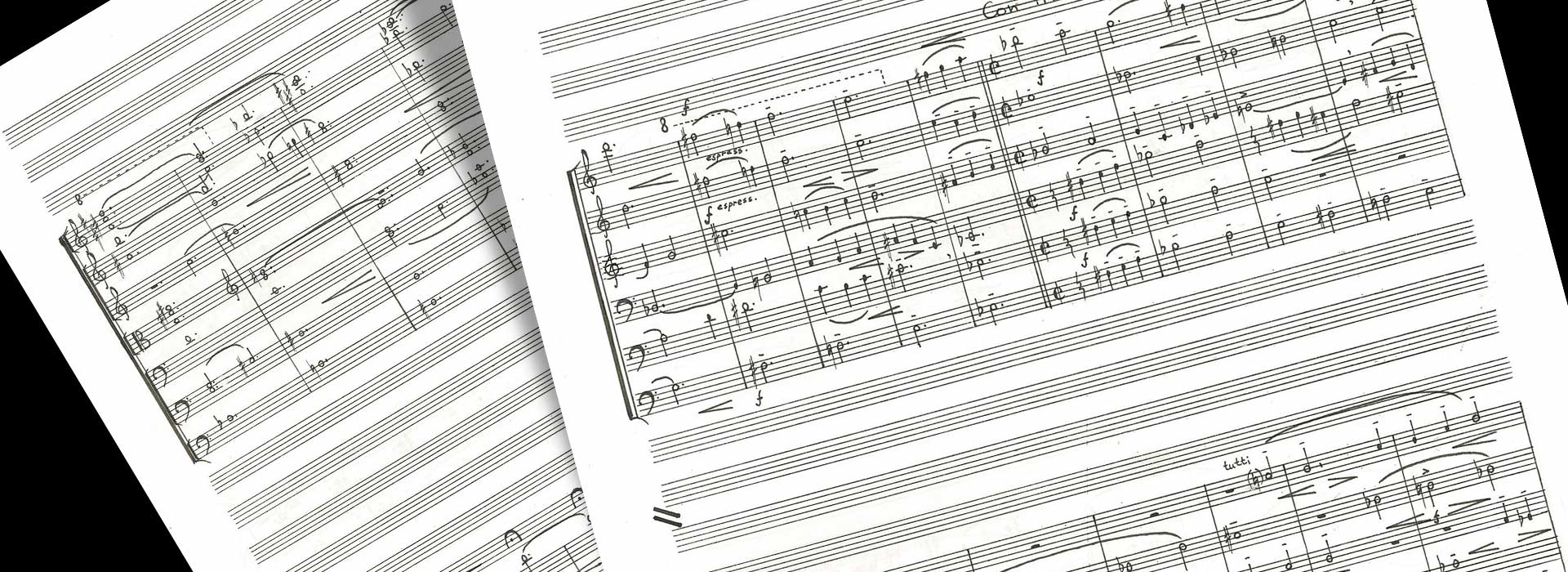
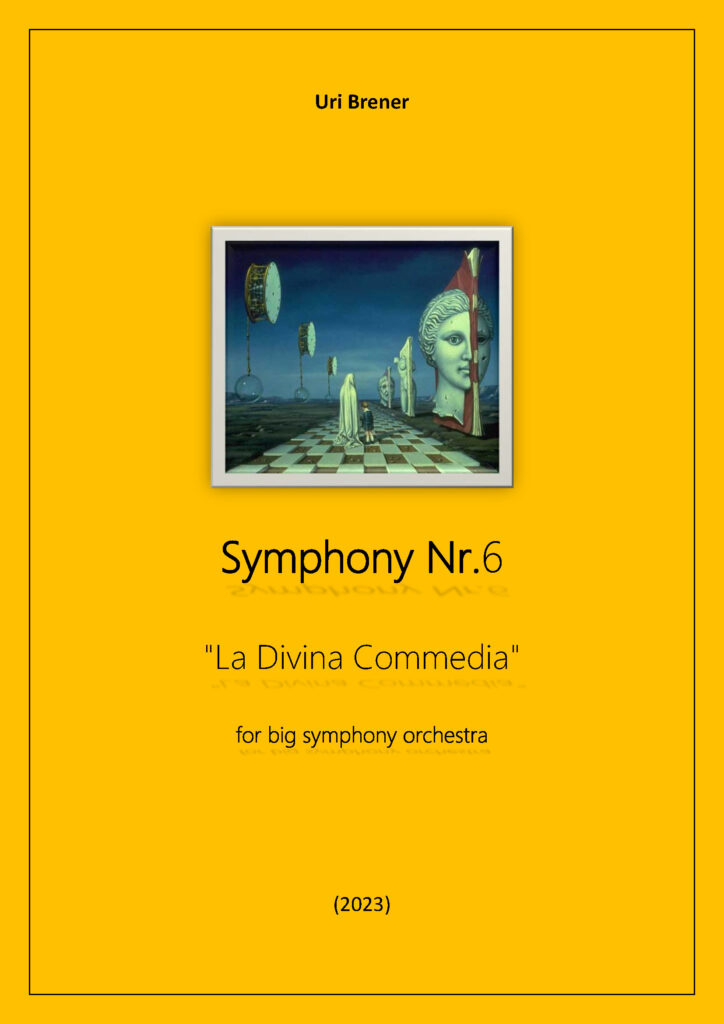
SYMPHONY № 6 “LA DIVINA COMMEDIA” (2023) FOR BIG SYMPHONIC ORCHESTRA (OP.119)
Symphony based on the master piece by Dante in four movements. It reflects upon the notion of afterlife in the Renaissance and it`s rethinking from the perspective of our time, specifically after the atrocities and the mass destruction that occurred in XX century.
I – “Midway upon the journey of our life, I found myself within a forest dark, for the straightforward pathway had been lost.” (Dante) [Dante`s wood. Three beasts. Virgil. Dante`s doubts. Beatrice`s spirit.]
II – “The path to paradise begins in hell.” (Dante) [Acheron. Circles of hell. Restless wind. Furies.]
III – “There is no greater sorrow than to recall happiness in times of misery.” (Dante) [The Wood of the Self-Murderers. Francesca da Rimini.]
IV – “Hell is empty and all the devils are here.” (William Shakespeare) [Tenth circle of hell, XX century.]
The Tenth or the last Circle of Hell:
Uri Brener’s Vision of Redemption Beyond Dante
Uri Brener’s symphonic piece, The Last Circle, inspired by Dante Alighieri’s Divine Comedy and William Shakespeare’s The Tempest, (“Hell is empty and all the devils are here“.) reimagines the concept of Hell for the modern age. By introducing a Tenth Circle of Hell, Brener confronts the atrocities of the 20th century, particularly the Holocaust, in a way that transcends Dante’s medieval framework. This bold artistic choice not only acknowledges the unparalleled horrors of modern history but also redefines Salvezza (redemption or deliverance) as a deeper, collective, and transformative process.
Why Brener Created the Tenth Circle
Dante’s Framework Was Insufficient for Modern Evil
Dante’s Inferno is a masterful exploration of sin, justice, and divine order. Its nine circles of Hell methodically categorize sins from lesser offenses, such as lust and gluttony, to the gravest sins, such as treachery. Each circle is proportional, reflecting the medieval belief in a finite and structured universe governed by divine justice. Yet, as profound as Dante’s vision is, it was shaped by the moral framework of the 14th century.
The atrocities of the 20th century, particularly the Holocaust, exceed the scope of Dante’s imagination. The mechanized extermination of millions of people, the industrial-scale slaughter of war, and the collapse of moral and ethical boundaries created a reality far beyond the proportional punishments of Dante’s Hell. Brener’s Tenth Circle addresses this inadequacy, providing a space for the horrors that defy Dante’s structured vision.
Hell Spilling Into the World
In Dante’s cosmology, Hell is a separate realm, hidden beneath the Earth—a destination for the damned, removed from the living world. Brener challenges this notion by drawing on Shakespeare’s line from The Tempest: “Hell is empty, and all the devils are here.” He posits that Hell has spilled into the world, manifesting itself in the actions of humanity. The Tenth Circle is not a metaphysical concept but a lived reality, where the boundaries between Hell and Earth dissolve.
Amplifying Emotional Impact
Dante’s Hell, though terrifying, is ultimately orderly and calculated. Each sin is punished with poetic justice, providing closure and a sense of divine balance. Brener’s Tenth Circle, by contrast, is chaotic, emotional, and unrelenting. The music reflects this. The musical narrative follows what is apparently the highest point of human atrocities and downfall – the World War, bringing death and destruction upon hundreds of millions, and the extermination of Jewish people, the Holocaust. The initial melancholic melody, reminiscent of Jewish Song or prayer is rudely interrupted and suppressed by rough military motifs, as if an army entering a small town and disrupting it`s peaceful existence. Ultimately one hears the screams and groaning of the innocent, everything becomes a mess, as music goes into a wild swirl, a dance of the Evil itself. After this, nothing is left but the drums roll, as if putting the humanity on trial. Nothing of this magnitude of atrocities could have been thought of or imagined even in the bloodiest dreams of a medieval man, with all his bigotry and Inquisition. That is why the nine circles described by Dante are just not enough to deal with an evil of these proportions, that is why we ought to see this as a Circle Ten, the Last Circle of Hell, circle that has been unleashed into this world in the 20th century.
Redemption Through Confrontation
In Dante’s vision, Salvezza is tied to divine grace and repentance. The journey from Hell to Paradise is a process of spiritual transcendence, where individuals confront their sins and seek salvation. Brener’s Salvezza, however, begins with a collective confrontation of humanity’s capacity for evil. The Tenth Circle forces us to acknowledge the darkness within ourselves and the world. Redemption in this context is not granted from above but must be earned through facing and understanding the depths of human depravity.
By presenting Hell as something that humanity has unleashed upon itself, Brener’s vision of redemption is more honest and grounded. It insists on accountability and the need for collective reckoning as a prelude to deliverance.
A Collective Responsibility
While Dante’s Divine Comedy emphasizes individual responsibility and salvation, Brener’s Salvezza is inherently collective.
The Holocaust, World Wars, and other atrocities of the 20th century were not the result of a single individual’s sins but the culmination of societal failures.
Brener’s music, with its layers of chaos and despair, reflects this shared culpability. His music symbolizes the judgment of humanity as a whole, not just of individual souls.
In this way, Brener’s Salvezza demands collective action and reflection. It calls upon humanity to take responsibility for its past and to work together to prevent such horrors from recurring. Redemption, therefore, becomes a communal effort rather than a solitary journey.
By acknowledging the unprecedented scale of modern evil, Brener opens the door to a new kind of redemption—one that rises above even the darkest moments of history. His music suggests that humanity’s capacity for good can be reclaimed, even in the aftermath of unimaginable horror. This universal vision of Salvezza speaks to all of humanity, offering a deeper and more inclusive hope.
Conclusion
Uri Brener’s The Last Circle is both a critique of Dante’s vision of Hell and a profound extension of it. By creating a Tenth Circle, Brener acknowledges the unparalleled horrors of modern history and forces us to confront the reality that Hell is not a distant, metaphysical realm but something humanity has brought into the world. His reimagining of Salvezza as a collective, transformative process makes it even more powerful than Dante’s. It calls upon us to face our darkest truths, take responsibility for our actions, and strive for a redemption that is earned through understanding, reflection, and collective effort.
Claudia Schulze