

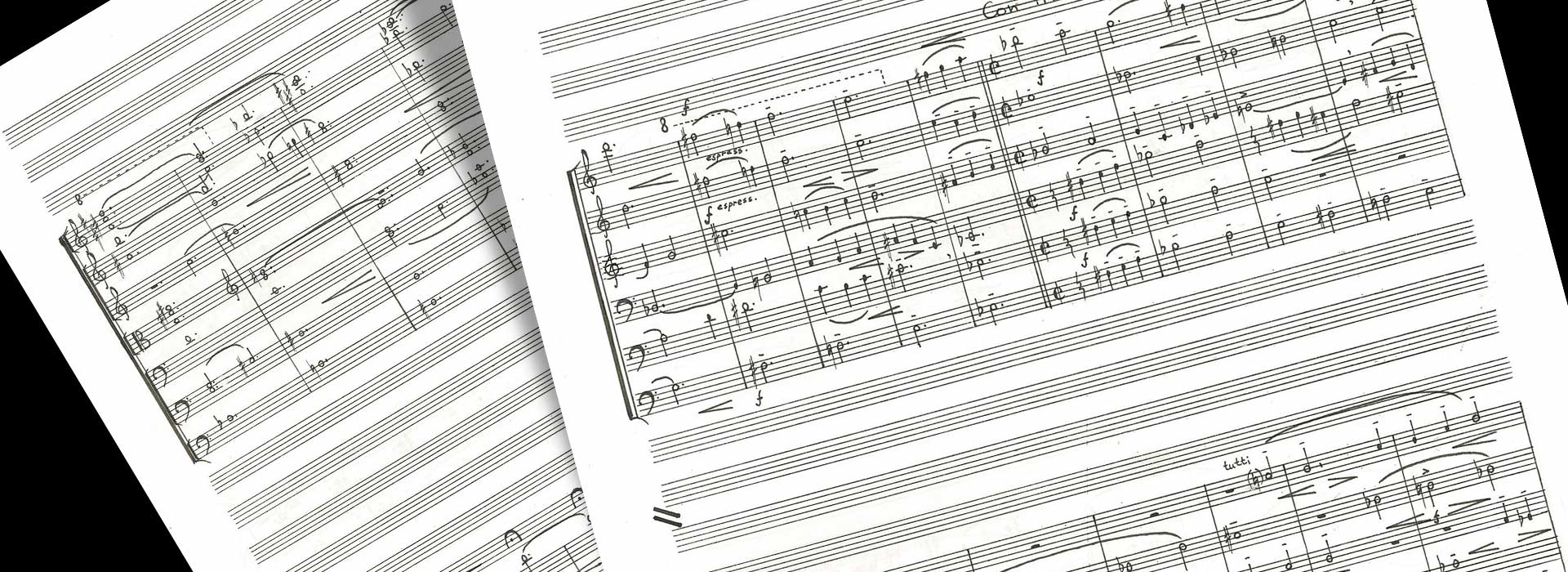
JEWISH SUITE סיפורי מעשיות VERSION FOR Horn/Fluegelhorn and piano (2018) OP.83F
( I. “At the Chotzer” II. “Almost a Lullaby” III. “BroigezTanz” IV. “Raava de Raava”)
“Jewish suite” is a series of musical pictures, presenting different aspects of live and spiritual environment in a traditional East-European Jewish community some 150 years ago, known as Shtetl. The music is very close in many aspects to a traditional folklore, such as klezmer, folk song or Chassidic niggun (chant); however, no actual quotations are used, all the music is entirely original. There are six parts to the Suite. Their names allude to following concepts:
- “At the Chotzer” (“At the Yard” or alternatively “At the Court”) – refers both to a physical yard of a house, but also, and more specifically, to the concept of the Chassidic so called “court”, semantically similar to that of a royal court. It includes all the people close to and lead by a single leader – a king in the case of a royal court, or a Tsaddik, Chassidic Rabbi, in the case of a “chotzer”.
- “Almost a Lullaby” is an attempt to express many complex feelings, fears and worries of a mother via a rather simple medium of a lullaby, whereby this basic simplicity gives a way to emotional outbursts, which are far beyond a mere effort to put a child to sleep. Hence “Almost” a Lullaby.
- “Broigez Tanz” (literally “The Dance of Fury”), the virtuoso finale, is a traditional musical form in klezmer music; it was customary used as a wedding dance (`dance of anger and reconciliation`) traditionally performed by the groom, his father, and his father-in-law. The music combines elements of dissonant sonorities with non-symmetric rhythmic figures and some invocation-like repeating phrases.
- “Raava de Raava” – this is the most mystical and inner part of the Suite, it`s spiritual “heart” as it were. The term comes from the Kabbalistic literature meaning in Aramaic literally “Desire of (all) desires”. It refers to a concept of the initial Divine intention (or “desire”) in creating the world, and revealing it to the people of Revelation, the Jewish people. According to the Kabbalistic knowledge, this most inner Divine Desire comes to its strongest manifestation at the time of Shabbat afternoon, close to the sunset, the time when it is customary in Chassidic circles to make a meal, embellished by beautiful and nostalgic chants (niggunim), sung by the whole congregation in a joint ecstatic rise.
Performances: December 8, 2019, Bunaysks, Old Synagogue, Dagestan Republic, Russia with Arkady Shilkloper; 10 October 2020, A.Stalsky Lezgin National Theater, Derbent, Dagestan Republic, Russia with Arkady Shilkloper